



By Rabbi Dr. Stuart Halpern
On March 25, 2026, Dr. Ruth Wisse delivered the Jefferson Lecture for the National Endowment for the Humanities. Being invited to offer this address is the highest honor the federal government bestows for distinguished intellectual achievement in the humanities. Her talk, “A Message from the Blue and White in the Red, White, and Blue,” offered recommendations in honor of America’s 250th birthday drawn from the wellspring of the story of Israel—whose modern national colors are blue and white—as laid out in the Hebrew Bible millennia ago.
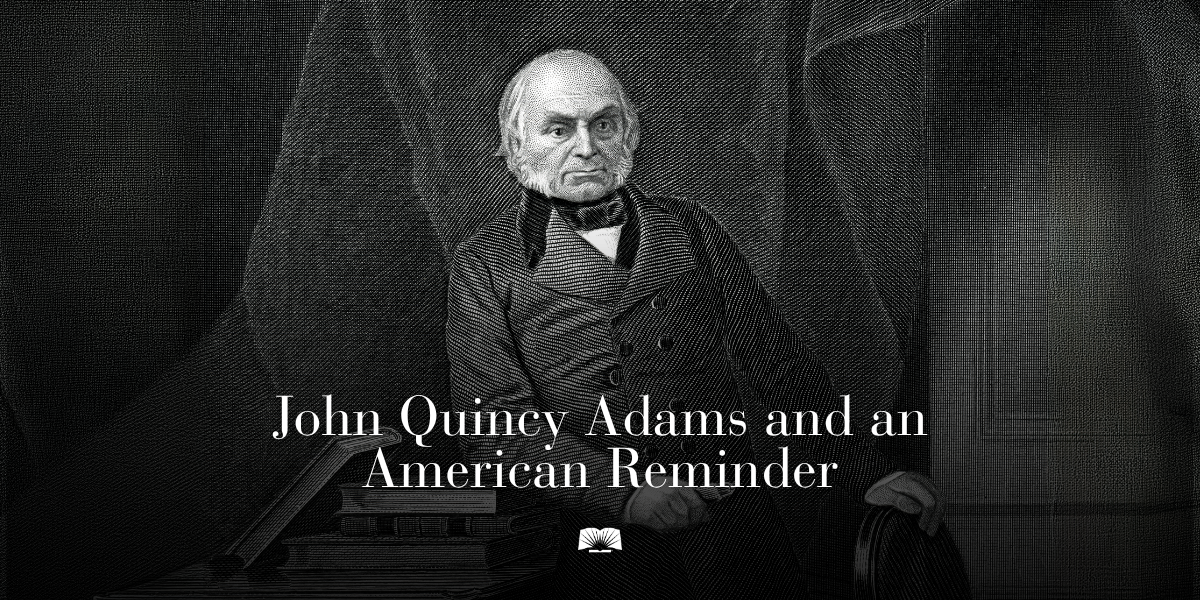
Remarkably, the talk unintentionally echoed a long-forgotten speech by John Quincy Adams, one of America’s foundational figures.
The Shema
Wisse drew particular focus to the prayer in Deuteronomy 6 known as the Shema, from the Hebrew word for “hear” that begins verse 4: “Hear, O Israel: The Lord our God, the Lord is one.”
The Shema, Wisse noted, “tells us to love God and follow His commandments.” The passage, then emphasizes, no less than seven times, the regularity with which commitment to the covenant must be expressed. “Teach them to your children (1). You shall speak of them when you sit in your home (2) and when you walk outdoors (3), when you lie down (4) and when you rise (5). You shall bind them as a sign upon your hand, and they shall be for a reminder between your eyes” (6).
This last part is understood by the Jewish tradition to mandate the wearing of tefillin, phylacteries, the small black boxes with leather straps that, as Wisse puts it, “join the head to the heart.” Then, Deuteronomy continues, “And you shall write them upon the doorposts of your house and upon your gates” (7), which is fulfilled by the presence of a mezuzah containing the Shema that is affixed to doorposts in Jewish homes.
Wisse warned that Americans can and should echo this Hebraic practice to ensure that the United States’s founding principles are sustained. “The absence of insistent, creative intellectual formation, particularly in the humanities, does not just leave a vacuum; it gets filled by adversarial ideas: Marx for Madison, Lenin for Lincoln, and lately the Islamist incursion for the American Revolution.… If there is to be enduring government of, by, and for the people,” she argued, “the people would have to be instructed and reminded to respect and confidently to perpetuate their precious inheritance.”
John Quincy Adams’s Jubilee
Strikingly, as Christopher Flannery has noted in a recent essay unrelated to Wisse’s remarks in the Claremont Review of Books, John Quincy Adams also saw the Shema prayer as a moral model for America.
On the 50th anniversary of George Washington’s presidential inauguration (April 30, 1839), Adams, then serving in his fifth term in the House of Representatives following his presidency, was invited by the New York Historical Society to deliver a commemorative address. Although Adams at that stage in his career was frequently asked to give speeches—and felt increasingly burdened by the task, doubting that he still had the energy and intellect to do them justice—he accepted on this particular occasion because he saw the event as an opportunity to highlight a pivotal moment in American history, the fiftieth anniversary of the ratification of the Constitution, which also fell around that time.
His speech, “The Jubilee of the Constitution,” was so lengthy that only part of it could be delivered publicly. The full written version stretched to 120 pages and quickly sold more than 8,000 copies. The speech was titled for the Jewish year of jubilee in Leviticus 25:10 (famously embossed on the Liberty Bell). And it ended with a paean to the Jewish Shema, as symbolic of the United States’s providential, divinely guided historical mission, which Adams saw as imitating that of ancient Israel.
“Fellow-citizens,” Adams contended, alluding to the gold-covered ark that held the two tablets, the locus of God’s covenant laws for Israel, “the ark of your covenant is the Declaration of Independence.” In encouraging his listeners and readers to recommit to “the principles of the Declaration of Independence, practically interwoven in the Constitution of the United States”—including primarily that the government is meant to secure the natural rights of people, who created in the image of God—he cited Deuteronomy’s divine advice:
Lay up these principles, then, in your hearts, and in your souls—bind them for signs upon your hands, that they may be as frontlets between your eyes—teach them to your children, speaking of them when sitting in your houses, when walking by the way, when lying down and when rising up—write them upon the doorplates of your houses, and upon your gates—cling to them as to the issues of life—adhere to them as to the cords of your eternal salvation.
Adams—long a Vice President of American Bible Society—was deeply aware of the Shema’s articulation of a system of covenantal loyalty, and thought that a nation founded on liberty would be wise to heed this model. He expressed his hope that if the citizens of the United States were loyal to their guiding values like the Jewish people of old,
“So may your children’s children at the next return of this day of jubilee, after a full century of experience under your national Constitution, celebrate it again in the full enjoyment of all the blessings recognized by you in the commemoration of this day, and of all the blessings promised to the children of Israel … as the reward of obedience to the law of God.”
This July 4th, then, is a perfect occasion for all Americans, regardless of creed, to consider cracking open Deuteronomy, turning to the 6th chapter, and reciting the Shema. Whether it inspires us to grow closer to God, put up a flag outside our window, dust off that copy of the Constitution collecting on our shelf, or even run for office, it beckons as a call to covenant that guides all those who would listen to its timeless teachings.
Rabbi Dr. Stuart Halpern, MBA, is co-editor of Jewish Roots of American Liberty (Encounter, 2025) and editor of The Promise of Liberty: A Passover Haggada (Koren Publishers, 2024).
