



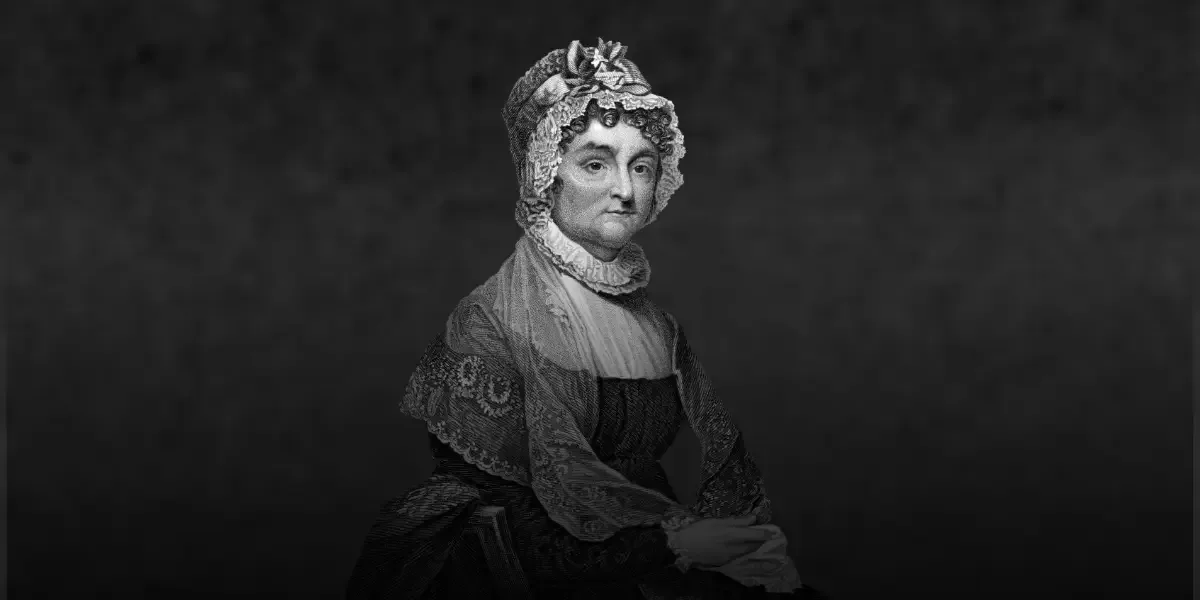
“Her price was indeed above rubies,” is how John Quincy Adams, America’s sixth president, mourned his mother, Abigail (1744–1818) in his diary upon her death. His reference to the description of the “Woman of Valor” in Proverbs 31:10 was apt. After all, Abigail’s life had been steeped in Scripture.
The future second First Lady was born on November 22, 1744, to the minister of the North Parish Congregational Church in Weymouth, Massachusetts. Sickly for much of her childhood, Abigail never received a formal education. But her mother Elizabeth taught her and her sisters to read and write, and Abigail developed a particular affinity for the Bible. Throughout her adult life, amidst the stirrings of what would become the American Revolution, as well as her husband’s political career and her education of their children and grandchildren, the Good Book served as a beacon of hope, comfort, insight, and uplift.
Familiar with All of Scripture
Though Abigail was a Christian and cited the New Testament throughout her copious letters to friends and family, the Hebrew Bible was a well into which her pen often dipped. As her husband, John, deliberated with delegates of the First Continental Congress in Philadelphia in September 1774, Abigail sent him a letter of support citing an ancient Jewish prophet as well as the Psalmist:
You have before you . . . the greatest national concerns that ever came before any people; and if the prayers and petitions ascend unto heaven which are daily offered for you, wisdom will flow down as a stream, and righteousness as the mighty waters [Amos 5:24], and your deliberations will make glad the cities of our God [Psalm 46:4].
The Psalms were a source of reassurance again as tensions were rising in early 1775, just two months before war broke out in Lexington and Concord. Writing to her close friend the historian Mercy Otis Warren, in a letter that evoked the biblical David’s own pleas to the Lord, she wrote:
[T]his now seems to be all that is left to Americans with unfeigned and penitent supplications to that Being who delights in the welfare of his creatures, and who we humbly hope will engage on our side, and who if we must go forth in defense of our injured and oppressed country will we hope deliver us from the hands of our enemies and those that persecute us [Psalm 31:15]. Though an host should encamp against us our hearts will not fear. Though war should rise against us, in this will we be confident [Psalm 27:3], that the Lord reigneth [Psalm 97:1]. Let thy Mercy, oh Lord, be upon us according as we hope in thee [Psalm 33:22].
Finding Comfort in the Covenant
After the bloody battle of Bunker Hill, in which the British obtained a costly victory, incurring more casualties than the Revolutionaries, Abigail sought comfort. Among the fallen on the Patriot side was Dr. Joseph Warren, a family friend. After learning of his death, she wrote to John, who was in Philadelphia meeting in the Continental Congress, in words surely meant to strengthen them both:
The race is not to the swift, nor the battle to the strong [Ecclesiastes 9:11], but the God of Israel is he that giveth strength and power unto his people [Psalm 68:35]. Trust in him at all times, ye people, pour out your hearts before him; God is a refuge for us [Psalm 62:8]. . . . Almighty God cover the heads of our countrymen, and be a shield to our dear friends. How many have fallen, we know not. The constant roar of the cannon is so distressing that we cannot eat, drink, or sleep. May we be supported and sustained in the dreadful conflict.
She also drew solace from the ancient Jewish leader Nehemiah, who had overcome countless obstacles in restoring Jerusalem’s walls to their glory:
We live in continual expectation of hostilities. Scarcely a day that does not produce some; but, like good Nehemiah, having made our prayer unto God, and set the people with their swords, their spears, and their bows, we will say unto them, “Be not ye afraid of them; remember the Lord, who is great and terrible, and fight for your brethren, your sons, and your daughters, your wives and your houses” [Nehemiah 4:14].
Revelation and Revolutionary Resolve
In another 1775 letter to Mercy Warren Adams, Abigail expressed a principle that she clearly held dear—that patriotism and belief in providence went hand in hand:
A patriot without religion in my estimation is as great a paradox, as an honest man without the fear of God. Is it possible that he whom no moral obligations bind, can have any real good will towards man, can he be a patriot who by an openly vicious conduct is undermining the very bonds of society, corrupting the morals of youth, and by his bad example injuring that very country he professes to patronize more than he can possibly compensate by his intrepidity, generosity, and honor? The Scriptures tell us righteousness exalteth a nation [Proverbs 14:34].
On March 17, 1776, the British evacuated Boston. Adams marveled how “we should be in peaceable possession of a town which we expected would cost us a river of blood, without one drop shed. Surely it is the Lord’s doing, and it is marvelous in our eyes [Psalm 118:23].”
In June of that year, she wrote to her husband how “He who fed the Israelites in the wilderness [Deuteronomy 8:16], who clothes the lilies of the field [Matthew 6:28] and feeds the young ravens when they cry [Job 38:41] will not forsake a people engaged in so righteous a cause, if we remember his loving-kindness.”
For most of 1778–79, John and Benjamin Franklin were in France seeking support for the war effort against England. Adams took his teenaged son, John Quincy, with him, leaving Abigail behind in Massachusetts with their four other children. In one of their correspondences, she reassured him that despite her worries, she was assuaged by the divine word:
I am sometimes thrown into an agony of distress. Distance, dangers, and oh, I cannot name all the fears which sometimes oppress me, and harrow up my soul. Yet must the common lot of man one day take place, whether we dwell in our native land or are far distant from it. That we rest under the shadow of the Almighty [Psalm 91:1] is the consolation to which I resort, and find that comfort which the world cannot give [John 14:27].
Following the war, John was once again in Europe, negotiating alliances that would support the newly independent United States. In 1784, Abigail sailed to meet him. She wrote to her sister of a sight on her ship that no doubt subliminally signaled to her the heavenly favor of the American endeavor:
I went last evening upon deck, at the invitation of Mr. Foster, to view that phenomenon of nature; a blazing ocean. A light flame spreads over the ocean in appearance; with thousands of thousands sparkling gems, resembling our fire flies in a dark night. It has a most beautiful appearance. I never view the ocean without being filled with ideas of the sublime, and am ready to break forth with the Psalmist, “Great and marvelous are thy works, Lord God Almighty; in Wisdom hast thou made them all” [Psalm 104:24].
First Lady in Faith
In 1780, Abigail Adams wrote to her thirteen-year-old son John Quincy (then on a trip to Europe with his father) reminding him to balance development of his character alongside political aspirations:
He that is slow to anger is better than the mighty, and he that ruleth his spirit than he that taketh a city [Proverbs 16:32]. This passion unrestrained by reason cooperating with power has produced the subversion of cities, the desolation of countries, the massacre of nations, and filled the world with injustice and oppression. . . . Having once obtained this self-government you will find a foundation laid for happiness to yourself and usefulness to mankind. “Virtue alone is happiness below,” [a quote from Alexander Pope] and consists in cultivating and improving every good inclination and in checking and subduing every propensity to evil.
That same year, she reiterated to John Quincy the inherent ties between spirituality and a flourishing polity:
The only sure and permanent foundation of virtue is religion. Let this important truth be engraven upon your heart, and that the foundation of religion is the belief of the one only God, and a just sense of his attributes as a Being infinitely wise, just, and good, to whom you owe the highest reverence, gratitude, and adoration, who superintends and governs all nature… , even to clothing the lilies of the field [Matthew 6:28] and hearing the young ravens when they cry [Psalm 147:9], but more particularly regards man whom he created after his own Image [Genesis 1:27] and breathed into him an immortal spirit [Genesis 2:7] capable of a happiness beyond the grave, to the attainment of which he is bound to the performance of certain duties which all tend to the happiness and welfare of society and are comprised in one short sentence expressive of universal benevolence, “Thou shalt love thy neighbor as thyself” [Leviticus 19:18].
In 1794, as Second Lady, she wrote to her daughter, Abigail Smith, who had two children of her own:
Train up, my dear daughter, your children, to a sober and serious sense of the duty which they owe to the Supreme Being. Impress their infant minds with a respect for the Sabbath [Exodus 20:8–11]. This is too much neglected by the rising generation. Accustom them to a constant attendance upon public worship, and enforce it by your own example and precept, as often as you can with any convenience attend. It is a duty, for which we are accountable to the Supreme Being.
When her husband was elected to the nation’s highest office, she wrote to congratulate him citing language borrowed from King Solomon:
You have this day to declare yourself head of a nation. And now O Lord my God thou hast made thy servant ruler over the people, [1 Kings 3:7] give unto him an understanding heart, that he may know how to go out, and come in [Deuteronomy 28:6] before this great people, that he may discern between good and bad, for who is able to judge this, thy so great people? [1 Kings 3:9; 2 Chronicles 1:10] …
Decades later, in 1816, she turned to the ending of Ecclesiastes in reaffirming this principle, telling John Quincy, the future Commander in Chief, “Life and immortality are brought to light only by the gospel. Good people cannot think alike, even upon important subjects. Fear God and keep his commandments, is the whole duty of man [Ecclesiastes 12:13], and his faith cannot be essentially wrong, whose life is in the right.”
“Oh, God! May I die the death of the righteous, and may my last end be like hers!” John Quincy’s mournful diary entry pleaded, drawing from Numbers 23:10. After all, Abigail Adams, America’s Woman of Valor, had lived a revolutionarily righteous life—full of faith in God and in the success of the American experiment.
Rabbi Dr. Stuart Halpern, MBA, is co-editor of Jewish Roots of American Liberty (Encounter, 2025) and editor of The Promise of Liberty: A Passover Haggada (Koren Publishers, 2024).
