



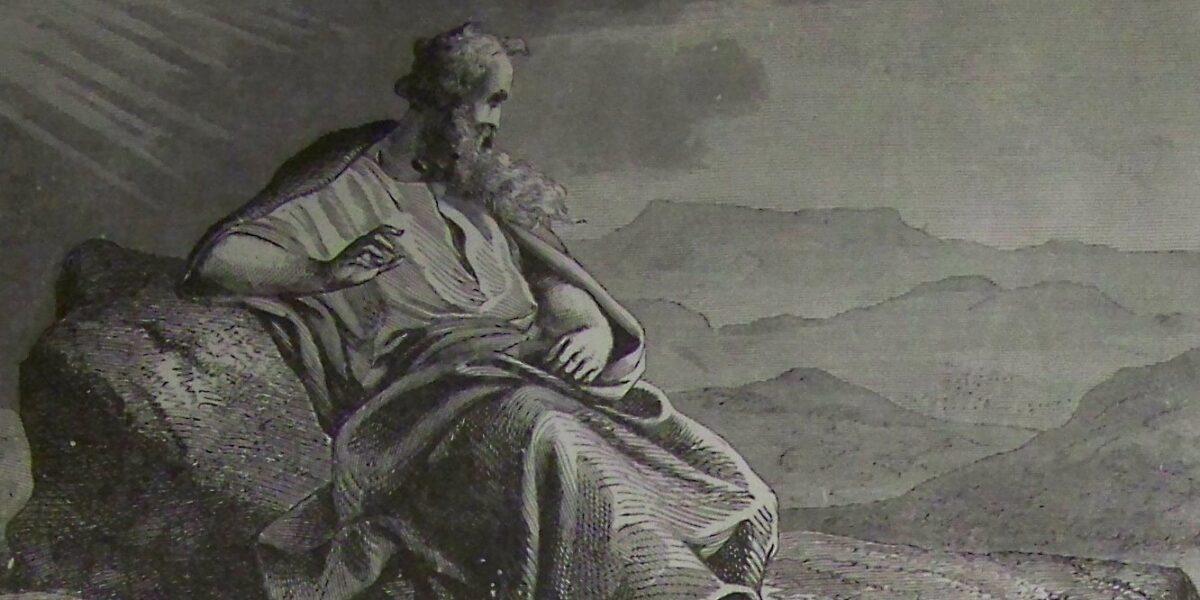
While Presidents’ Day officially celebrates George Washington’s birthday, it’s the perfect occasion to note the impact on the American story of another seminal figure—Moses, who has served as an inspiration to Commanders in Chief since our country’s earliest days.
The Founders and the Exodus from England
On May 17, 1776, on which the Continental Congress held a “day of Humiliation, Fasting and Prayer” to elicit God’s assistance in the Revolution, John Adams wrote to his beloved wife Abigail. He recounted that he had heard a sermon featuring “a Parallel between the Case of Israel and that of America, and between the Conduct of Pharaoh and that of George.” The sermon had “concluded that the Course of Events, indicated strongly the Design of Providence that We should be separated [sic] from G. Britain.” Such an exodus would need someone to lead it, of course, and Adams ruminated:
“Is it not a Saying of Moses, who am I, that I should go in and out before this great People? [Exodus 3:11, but see 2 Chronicles 1:10] When I consider the great Events which are passed, and those greater which are rapidly advancing, and that I may have been instrumental of touching some Springs, and turning some small Wheels, which have had and will have such Effects, I feel an Awe upon my Mind, which is not easily described.”
While Adams would eventually serve as America’s second president, it was the first, Washington, who emerged as most Moses-like. New Hampshire’s Peter Folsom summed up the sentiment of the times by noting how “Moses led the Israelites through the red sea; has not Washington conducted the Americans thro’ seas of blood?” Massachusetts pastor Eli Forbes saw Washington as an even greater figure than his predecessor, since Moses had died on the precipice of the Promised Land while Washington had seen his mission through to its end. Forbes suggested that Moses was actually “the Washington of Israel.”
As the legal scholar Daniel Slate has noted, Moses was not the only biblical character to whom Washington was compared. On December 11, 1783, George Duffield, pastor of Philadelphia’s Third Presbyterian Church, discussed “our American Zion,” in a sermon expressing gratitude for American independence. He spoke admiringly about “the illustrious Washington, the Joshua of the day,” operating as leader “of his chosen states.” On May 12, 1785, another preacher, Yale’s Samuel Wales, compared the president to “a Moses, a Joshua, or a Samuel.” When Timothy Dwight published America’s first major epic poem, “The Conquest of Canaan by Joshua,” the author wrote to Washington that he dedicated the book to him.
The Great Emancipator and the Ancient Prophet
Abraham Lincoln was shot on Good Friday, April 14, 1865, during the Jewish holiday of Passover, which celebrates Moses leading the Israelites out of Egypt. “Like our own lawgiver, Moses,” noted Sabato Morais a few days later in a sermon at Philadelphia’s Congregation Mikveh Israel, Lincoln “brought a nation to the verge of the haven of peace, and, like him, [was] not allowed to participate in its consummation.”
It wasn’t only Jews who thought of America’s Great Emancipator as paralleling the biblical figure. Reverend John Falkner Blake of Christ Church in Bridgeport, Connecticut, told his flock, “I know the depth of your love for our murdered President, and therefore I ask you to weep with me to-day while we consider his late relations to us as a people. As I ponder over them, they seem to me to bear a striking analogy to those which Moses sustained to the children of Israel.” He continued: “[W]e had all become slaves, and as God sent Moses to deliver the children of Israel from slavery, so, I believe, he sent Abraham Lincoln to deliver us.”
Others echoed the sentiment. Reverend Charles S. Robinson of the First Presbyterian Church in Brooklyn, New York tried to capture the feelings of the freed slaves when he lamented, “I think, more than all, of the poor freedmen, when they hear of the President’s death. How they will wonder, and will wail! They called him ‘Father,’ as if it were part of his name. Oh, they believed in Abraham Lincoln! They expected him, as the Israelites did Moses.” And Rev. Samuel Gorman of the First Baptist Church in Canton, Ohio noted that the late leader “will be remembered by his friends, as the Benefactor of our Republic and of our race. And how precious will be his memory to the millions whom he has helped to free! He will be to them as Moses has ever been to the Jews. This generation will tell of his greatness and goodness to the next, and so on, down to the end of time.”
He Who Is Now Moses Used to Be Pharaoh
The post-assassination consensus of Lincoln-as-Moses was somewhat ironic, since, as John Coffey notes in his Exodus and Liberation, while the president was alive, many had spoken of him as Pharaoh. “Rather than leading a new Exodus for the nation’s black slaves,” Coffey writes, “the president had made it clear that the war was being fought to maintain the Union, not to abolish slavery. . . . The Pennsylvania Anti-Slavery Society suggested that ‘the President has it now in his power, as had Pharaoh of old, to let the oppressed go free.’” The abolitionist newspaper, The Liberator, even printed a “Dialogue between Pharaoh and Moses” “submitted to the attention of Pres. Lincoln,” in which the tyrannical monarch negotiates with Moses: “We are all in favor of liberty, of course; but this subject must not be meddled with. It excites some of my people. I tell you, I will not let them go.”
Even the Emancipation Proclamation, which only provided for the liberation of Confederate slaves, did not quiet Lincoln’s critics. A black newspaper complained that the Union needed black troops and was now “at the feet of the despised negro . . . as the King of Egypt in his sorrow was brought to the feet of his slaves Moses and Aaron, saying, ‘Bless me also’” [Exodus 12:32].
The Sequel Is Always a Disappointment
After Lincoln’s assassination, he was succeeded by his Vice President, Andrew Johnson. Moses had been summoned by him, too. During the 1864 campaign, Johnson had denounced slavery before a gathering of African Americans in Nashville, and suggested that “as in the days of old, a Moses might arise who should lead them safely to their promised land of freedom and happiness.” Someone in the audience responded by shouting, “You are our Moses,” to which Johnson responded: “Humble and unworthy as I am, if no better shall be found, I will indeed be your Moses, and lead you through the Red Sea of war and bondage, to a fairer future of liberty and peace.” But Johnson proved an unworthy successor to the martyred Lincoln. By 1865, African American leaders like Lewis Hayden were bemoaning: “deliver us from such a Moses.”
More Modern-Day Moseses
The motif of connecting presidents with Moses hasn’t abated in recent administrations.
Saturday Night Live aired a 1997 skit with Bill Clinton negotiating over the giving of the Ten Commandments (“Yeah, right. Look, Moses—hear me out on this one, okay? Is it technically adultery . . . ?”).
George Bush cited the “truths of Sinai” as one of the moral guideposts of the United States, and a popular joke during his time in office recounted the president seeing in a crowd a person who he thought was the Jewish leader. “Yes, I am Moses,” the man replied, “but the last time I spoke to a bush, I spent 40 years wandering in the wilderness.”
“We are in the presence of a lot of Moseses,” said then-candidate Barack Obama while speaking in Selma, Alabama, in front of civil rights pioneers.
More recently, during Passover in 2025, Fox News pundit Charlie Hurt remarked to U.S. Ambassador Israel Mike Huckabee, “Nobody’s better on biblical history than you are. Can Trump be the biblical Moses?” to which Huckabee responded that the president was working on freeing the Israeli hostages taken by Hamas, which Trump did a few months later.
While one might disagree with the politics, policies, or personalities of these presidents, it is clear that Israel’s divinely designated leader will continue to serve as a prism through which to view our elected leaders for many decades to come.
Rabbi Dr. Stuart Halpern, MBA, is co-editor of Jewish Roots of American Liberty (Encounter, 2025) and editor of The Promise of Liberty: A Passover Haggada (Koren Publishers, 2024).
